
For any business in the restoration industry, SEO plays an essential role that may be vital to the business and its development or huge let down. So the longer consumer audiences are using search engines to look for restoration services providers, companies must make sure that there is they are high ranked. Such visibility not only directs traffic to their websites but also helps to establish credibility, where potential clients go to search for valid information.
The level of competition that characterizes the restoration industry increases the need for proper search engine optimization strategies. The need may arise from water damage, fire, or mold issues that require urgent solutions when the families are under intense pressure. Such as, by constantly optimizing for relevant searches, restoration companies make sure they rank well when the time for people to look for these services is due and be seen as a viable option for distressed homeowners to turn to.
Furthermore, it suggests that positive SEO helps in enhancing the overall business presence online. This includes the local SEO, which is very essential for firms in the restoration sector who depend on clients in their immediate locality. This demonstrates that creating robust local rankings can in turn increase physical traffic and direct clientele, therefore increasing sales.
Well, in this extensive article, we are going to discuss the most effective strategies focusing on the SEO needed for the restoration industry. From the keyword research to writing articles and obtaining links for your articles and creating relevant content we will bring value with the goal of increasing the number of clients visiting your restoration business.
What is Restoration SEO?
Restoration SEO can be defined as the specific use of SEO strategies as applied to organizations within the restoration niches. This includes various techniques that would help in improving website traffic, finding potential clients, and finally convert them. The basis of restoration SEO is keyword analysis, which helps to determine the terms that people are using to find a particular service such as water damage restoration or fire damage restoration.
Other than keyword optimization, local SEO should also be considered. Restoration firms operate within a geographical location, which means that it is crucial to appear on the first page of local searches. This comprises Google My Business listing optimization, collecting reviews, and checking online citations.
The creation of content is also important as it can make businesses look like experts in the field while providing quality content that can help improve the search engine results. Thus, by considering and employing mentioned elements, the companies in question can address the target audiences’ needs in the shortest time possible during the crises.
The Basics of SEO for the Restoration Industry
SEO is a broad term that implies the set of processes, methods, and activities that will help your website become more relevant to search engines and users. Some key components include:
- Local SEO: Local SEO, specifically for restoration companies, refers to the processes aimed at making your business rank higher in local search engine results. This can be important to restoration contractors mainly because many of their clients are likely to be local.
- Technical SEO: Technical SEO carried out for restoration technicians has to deal with content that is implemented on the site and aims at increasing its ranking on the results page. This may comprise code optimization, improving the loading time, and the ability to run on a mobile device.
- On-Page SEO: On-page SEO is the process of increasing the ranking of every page in your website to direct high quality traffic to them. Activities that need to be observed by the restoration technicians include generating content that is useful and of high quality, the use of the keywords in the headings and titles as well as the use of alt tags in the image descriptions.
- Off-Page SEO: Off page SEO is sometimes considered the most difficult part of SEO and concerns creating authority and backlinks to a website to raise its rank in the search results. High quality inbound links improves the standing of your site in the eyes of Google, which looks at the authority of restoration sites in its search engine results page.
- Keyword Research: Keyword research is the fundamental concept in SEO that enables people to understand the most popular and relevant terms to use in their given area of interest. It is important for a restoration business to have a general idea of the keywords that their customers are using when looking for any services related to yours. You should determine terms that clients may use when searching for services or products on the web and use them. This is how, when you use these keywords and phrases while setting your site, you will be able to draw more persons and hence have a better search engine result.
- Content creation: The informational content must be of high quality for the companies to benefit through attracting clients towards their services. In addition to bringing in more clientele because it puts you in a position of authority, it also enhances your stand with search engines because it serves as a resource to those users that are looking for a answer or a solution to their problems.
- Link Building: Link building is one of the fundamental processes used in SEO in the restoration industry. By managing to attract good quality inbound links from other good sites, you are able to enhance the ranking of your site in the search engines.
Also Read: Importance of Google Business Profile for the Restoration Industry!
The Benefits of SEO for Restoration Businesses
Various improvements may be obtained from the integration of proper SEO processes for restoration companies. Let’s explore some of the most significant advantages:
1. Increased Visibility and Brand Awareness
Based on the analysis, the general advantage of SEO available to restoration companies is the higher ranking of their websites. This is because when your website has a higher rank for the particular keywords, interested customers will have higher brand exposure. This isolation can prove highly useful in an industry where recommendations and referrals from clients are a major factor in the choice of a service provider.
2. Targeted Traffic and Higher Quality Leads
Through applying SEO services, the targeted traffic is being driven towards the website because the strategy targets only keywords and phrases that contain details of the services to be rendered. What this means is that the people who are visiting your site from the organic search results are likely to be in need of restoration services. Hence, better quality leads and your advertising budget are more likely to be well spent than when you are targeting random visitors.
3. Cost-Effective Marketing
Thus, SEO appears to be a long-term solution for attracting clients when compared to other more expensive traditional or paid advertisement techniques or paid online marketing strategies. Although there might be an investment of time and money in order to acquire traffic through organic search, converting it to a source of leads with ongoing flows without having to continue paying for ads.
4. Building Trust and Credibility
Evaluating your site’s rank in the search engine for the right keywords can give your restoration business credibility. This is due to the fact that a number of users are inclined to have more trust in the sites that rank at the top. By being in the first rank consistently and offering relevant information, people will associate your company with knowledge regarding restoration work.
5. Improved User Experience
Search engine optimization commonly works hand in hand with comprehending the experience of the visitors to your website. This includes making your site easier to navigate, faster loading, and optimized for mobile, all of which are not only important for search engine optimization but will further improve the chances of potential clients finding the information they need and then approaching your firm for services.
6. Competitive Advantage
In the competitive market of restoration firms, a good SEO plan will surely put you ahead of your competitors, who may not be very considerate with their rankings. When your store or service appears at the top of search results for any keyword related to the restoration business, you take the biggest piece of the pie of all the potential customers out there.
Key SEO Strategies for Restoration Companies
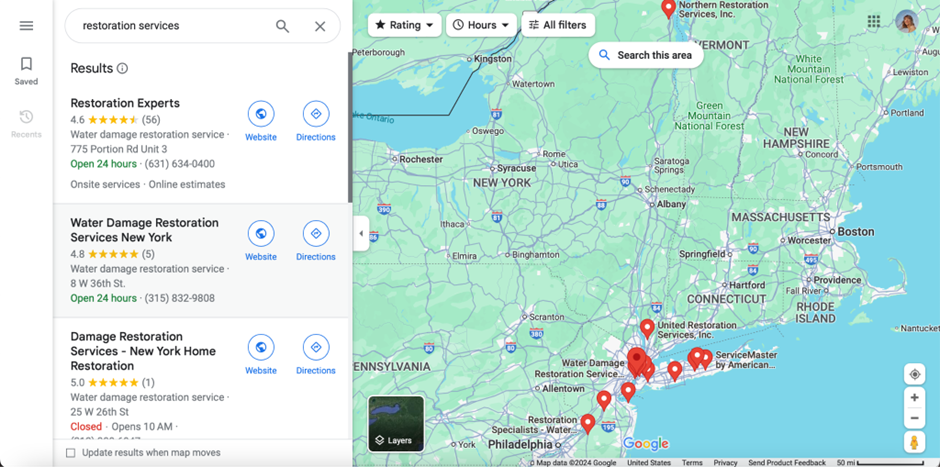
Prior to advancing to the next level, allow me to provide insight regarding the essential components of SEO that need to be enacted to fully maximize its potential in boosting your restoration business.
1. Keyword Research and Optimization
So, keyword research is the most crucial aspect of any effective SEO campaign. For restoration companies, it is about pinpointing the terms and key phrases many users are using when searching for your business.
1. Emergency-related keywords: Pay attention to terms that suggest immediate service or product required, especially in cases of disaster relief like ‘emergency water damage repair’ or ‘24/7 fire restoration services’.
2. Service-specific keywords: Target specific keywords which can be linked to a particular service you provide, for instance, ‘mold remediation’ or ‘storm damage restoration’.
3. Location-based keywords: Add more locality-dependent names and surnames specific to the region where the service is provided, for example, city or district names.
4. Long-tail keywords: Do not ignore longer and much longer keywords and phrases, including less competition and a lot of interest, for instance, how to fix water damage in the basement.
As soon as you are doing keyword research, use these keywords in the appropriate places on your website as follows: page title, header, meta description, and the main content.
2. Local SEO Optimization
Local SEO is important for restoration companies that operate in specific regions, so here are some key tactics to improve your local search presence:
- Google My Business Optimization: To increase the chances of ranking on the maps, ensure that you claim your Google My Business listing and complete the profile, add images, and update the information consistently.
- Local citations: Also, once you establish your online presence, make sure that your business information, such as name, address, and phone number, are all consistent across the spectrum of online directories and platforms.
- Location-specific landing pages: Ensure that you have unique pages that are entirely focused on the service areas that you offer. So, make sure to include local search keywords on the individual pages.
- Local link building: It is advised that you look for chances of exchanging links with other businesses, clubs, and media houses within your locality.
- Customer Reviews: Request satisfied clients to leave feedback on your service on your Google My Business profile and other business pages.
3. Content Creation and Optimization
The content you are posting on your website has to be top-notch and provide the necessary information to support and promote SEO efforts as well as to demonstrate the expertise of your company in the sphere of restoration. undefined.
- Blog Posts: Periodically, post articles about emergent problems and risks associated with restoration, along with details on existing tendencies.
- Service Pages: Develop separate website sections for every restoration service you provide and include comprehensive information on each and answers to questions related to the service.
- Case Studies: Explain how you would show previous restoration projects that have been implemented to prove your prowess when doing these jobs for potential clients.
- Educational Resources: Create guides, infographics, or videos that property owners can find useful if they have faced different types of losses.
- Local Content: Provide information on restoration within your service areas, noting difficulties or rules unique to specific regions.
4. Technical SEO Improvements
The technicalities of your site’s construction play a massive role in its search rankings and the experience of users who visit the site. Key areas to focus on include:
- Site speed optimization: Speed up your website by managing images, browser cache, and other codes that slow down websites.
- Mobile responsiveness: Make sure that your site is fully responsive, especially to mobile devices such as phones and tablets.
- Secure connection: The changes are to adopt HTTPS protocol for the security of users’ information and improvement of search engine results.
- XML sitemap: Submitting sitemaps in the different search engines to assist them to crawl and arrange your site at their ease.
- Structured data markup: Use rich snippets by giving schema markup for content for the search engines to improve your search listing.
5. Link Building and Digital PR
To be honest, the maintenance of high-quality backlinks remains still a key attribute in achieving the SEO goal. For restoration companies, consider these link-building strategies:
- Industry Partnerships: Exchange links with companies or organizations allied with your business, for example, insurance companies, real estate companies, and others.
- Guest Posting: Another useful strategy is to write an article for established industry media or local papers/newspapers.
- Resource Link Building: Create valuable resources that other websites in the restoration and property management industries would want to link to.
- Local Sponsorships: Submit your site to local events or organizations, which will help you in gaining backlinks and local relevance to your site.
- Press Releases: Issue press releases for matters that include company announcements and or social responsibility projects.
Also Read: Automated Email Follow-Ups for the Restoration Industry!
How Can You Analyze SEO Success in Your Restoration Industry

Nonetheless, to guarantee your SEO effort is fruitful, tracking as well as measuring your performances frequently is central. So, key metrics to monitor your success include:
- Organic Search Traffic: Record the amount of traffic that comes from organic search results.
- Keyword rankings: Keep an eye on positions for the keywords, especially those with high levels of commercial relevance.
- Conversion rates: Determine the percentage of site visitors that are converting into leads or customers.
- Local pack appearances: Measure how frequently your business shows up in Google’s local pack for the targeted keywords.
- Backlink profile: Keep an eye on the quality and the number of backlinks pointing to your website.
- Page load times: Monitor the speed performance of your site, as this determines user experience and search engines’ ranking.
- Bounce rate and time on site: Engagement metrics can also be utilized to determine the degree of relevance of your content to the users.
FAQs
1. How long does it take to see results from SEO for the restoration industry company?
SEO is not an immediate approach to marketing, and there can be differences in the span of getting outcomes based on several factors. These are as follows: the current internet presence you have, the intensity of competition you are likely to face in your target market, and your ability to conduct SEO. Normally, you can expect a slight increase in both rankings and traffic in a period of 3 to 6 months after the adoption of the SEO strategies.
However it is a fact that intensive outcomes may not accrue in a short time of between 3-6 months, but rather 6-12 months or more may be experienced. This is something any SEO expert will be quick to emphasize. SEO is not a one-time event or process. Nothing comes easy, and so it is with SEO; therefore, make sure that you are constant in your approach and that you take your time while making the alterations.
2. Is local SEO different from general SEO for the restoration industry?
While local SEO and general SEO share many fundamental principles, they do have distinct focuses that are particularly relevant for restoration businesses. Local SEO specifically aims to improve your visibility in local search results, which is crucial for restoration companies serving specific geographic areas. This involves optimizing for location-based keywords, managing Google My Business listings, building local citations, and earning reviews from local customers.
On the other hand, general SEO, as regularly pointed out, targets more the common topics in the industries and may seek the rank of the site within the nation or even the entire world. For most restoration businesses, it is crucial to establish a local SEO promotion plan because your business needs to appear when people in need of a quick restoration service near them search online.
3. How can I optimize my restoration website for voice search?
Optimizing for voice search is becoming increasingly important as more people use voice assistants to find services. To optimize your restoration website for voice search, focus on using long-tail, conversational keywords that mimic how people speak. Create FAQ pages that address common questions about restoration services using natural language.
Ensure your Google My Business listing is complete and accurate, as voice assistants often pull information from these listings. Optimize for local search, as many voice searches have local intent. Additionally, improve your website’s loading speed and mobile-friendliness, as these factors affect voice search results.
4. How can I build quality backlinks for my restoration business?
Building quality backlinks for your restoration business requires a strategic approach focused on creating value and fostering relationships. Start by creating valuable, shareable content such as comprehensive guides on dealing with water damage or infographics about fire prevention.
Seek opportunities to guest post on reputable industry blogs or local news sites, sharing your expertise with a wider audience. Participate in or sponsor local events and request a backlink in return. Collaborate with complementary businesses, like insurance agencies or real estate companies, for mutual link exchanges.
5. How often should I update my restoration company’s website for SEO purposes?
Regular updates to your restoration company’s website are beneficial for SEO, but the frequency can vary depending on your resources and the nature of your business. Aim to add new blog posts or articles at least 2-4 times per month, addressing common restoration issues, answering frequently asked questions, or discussing industry trends.
Review and update your core service pages quarterly to ensure the information remains accurate and relevant. Any changes to your contact information or business hours should be updated immediately. Conduct a comprehensive SEO audit annually to identify areas for improvement. Monitor your website’s performance and user experience metrics monthly, making adjustments as needed.
Conclusion
In such an environment where response, time and more importantly trust, SEO for the restoration industry is an essential factor for companies that seek to establish themselves online. By developing an extensive SEO strategy that will reveal all the peculiarities of the restoration industry, businesses can promote their companies, attract the highest quality leads, and become leaders on the market.
From optimizing for local search to creating valuable content that addresses both emergency needs and long-term property care, SEO offers a multifaceted approach to growing your restoration business. While the landscape of search engine optimization continues to evolve, the fundamental principles of providing value to users and demonstrating expertise remain constant.
SEO investment is actually quite reasonable as not only companies that work in restoration areas can increase their positions in search results but also create a stable and secure online presence that will help to achieve many business objectives in the future. Finally, SEO can be a serious deciding factor between an organization’s success and its simple survival in the field of restoration in the future as the competition in the market grows.